Chinese energy storage manufacturer and BNEF Tier 1 supplier offering C&I and utility-scale BESS. Full-stack self-developed systems including BMS, EMS, and cloud platform.
Chinese state-owned rolling stock and energy group, ranked #3 globally in BESS integration by market share. Offers liquid-cooled containerized energy storage systems.
Product-focused BESS manufacturer specializing in integrated AC block solutions for C&I and utility-scale markets. FlexCombo delivers integrated BMS, PCS, and fire protection in a standardized cabinet with grid-forming capability.
Top 4 global BESS integrator (Wood Mackenzie) and BloombergNEF Tier 1 manufacturer with 30+ GWh deployed across 300+ projects. Gen 8 Scalable Platform features proprietary 750Ah+ LFP cells in modular 10-foot units supporting 6-12+ MWh configurations with 440+ Wh/L energy density.
Chinese energy storage manufacturer and BNEF Tier 1 supplier, ranked among China's top 3 C&I storage providers. Full-stack self-developed systems with 3S integration.
South Korean heavy industries conglomerate and BESS system integrator offering PCS and complete energy storage systems. Over 3 GWh delivered since 2009.
Chinese C&I energy storage specialist and BNEF Tier 1 manufacturer. China's #1 user-side energy storage integrator with over 1,000 projects and 20,000 eBlock units deployed.
Energy storage division of JinkoSolar and BNEF Tier 1 manufacturer, offering utility-scale and C&I battery energy storage systems built on in-house LFP cell technology. SunTera containers deliver up to 6.25 MWh per 20ft unit with 10,000+ cycle life.
Chinese smart grid and energy storage company listed on the Shanghai Stock Exchange. Offers liquid-cooled battery containers, energy storage cabinets, and integrated EMS platforms.
Swiss-headquartered energy storage company manufacturing LFP-based BESS solutions in Turkey. Product range spans utility-scale DC containers and MV skids to commercial AC cabinets.
Shenzhen-based energy storage inverter manufacturer. 5 GW+ cumulative deliveries across residential, C&I, and utility-scale applications in 36 countries.
Finnish power electronics company designing and manufacturing grid-forming BESS and STATCOM solutions. Arctic-grade systems operating down to -40 °C with 95-98% efficiency.
Vertically integrated energy storage company manufacturing LFP cells (280Ah to 783Ah solid-state) and containerized BESS up to 8.3 MWh per unit. Over 8 GWh installed globally across 40+ countries with 260+ safety certifications and pioneering solid-state battery technology.
Leading modular LFP battery system manufacturer for C&I and utility-scale BESS. Container-based L-series and PowerCube rack systems are deployed across European and APAC markets.
Chinese BESS manufacturer offering modular cabinet and container energy storage from 120 kWh to 5 MWh, standalone PCS, and smart microgrid controllers.
BloombergNEF Tier 1 energy storage manufacturer that expanded from solar into comprehensive BESS solutions through subsidiary SYL Battery. Offers vertically integrated products spanning LFP cells, modules, PCS, and containerized systems with 15 GWh+ annual production capacity.
Global energy management company offering a containerized AC-coupled BESS for commercial and industrial microgrids in the North American market, integrated with EcoStruxure controls.
Global energy technology company providing SINACON BESS systems from PCS to full AC block and SCADA. Targets utility-scale grid stability applications with turnkey solutions.
Chinese publicly listed smart energy company specializing in PV inverters and energy storage systems. Manufactures utility-scale PCS and battery containers (ORI series) as well as commercial and industrial integrated storage solutions.
BloombergNEF Tier 1 energy storage manufacturer with vertically integrated LFP cell production (102Ah to 684Ah) and containerized BESS systems. NoahX 3.0 delivers 6.528 MWh per 20ft container with 15,000+ cycle life and AI-based active balancing.
Utility-scale BESS supplier that deployed 46.7 GWh in 2025. Megapack 2 XL delivers 3.9 MWh per unit with integrated inverters, BMS and thermal management.
Volvo Group's energy storage division offering modular BESS for C&I applications, EV charging infrastructure, and grid support. Second-life battery capable.
Shanghai-based energy storage company and BNEF Tier 1 manufacturer with 14 GWh manufacturing capacity. Offers modular BESS solutions for C&I and utility-scale applications.
Chinese BESS manufacturer specializing in PCS, battery packs, BMS, and complete energy storage systems. Top 10 Chinese utility-scale BESS OEM supplier with 100+ large-scale projects installed globally.
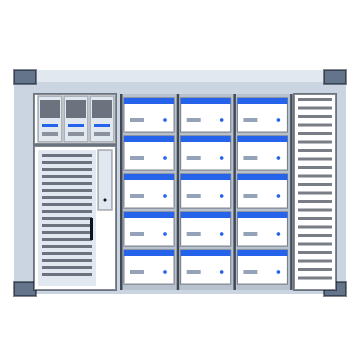
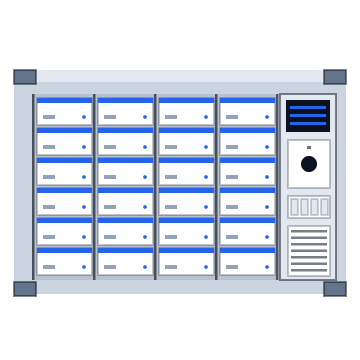
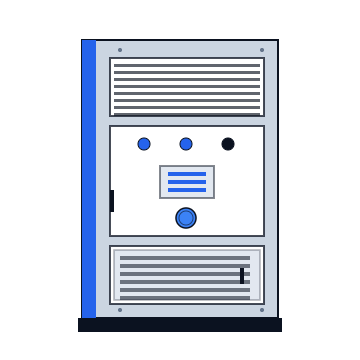
An AC block is a fully integrated battery energy storage product that combines battery modules, BMS, thermal management, and PCS (power conversion system) into a single unit. Unlike DC blocks, which require an external inverter, an AC block delivers grid-compatible AC directly. For procurement teams, this all-in-one architecture simplifies system integration, reduces the number of supplier relationships, and lowers BoP complexity.
AC blocks are most commonly deployed in C&I applications and smaller utility-scale projects where simplicity and rapid commissioning take priority. For larger projects, separate DC block and PCS procurement offers more architectural flexibility and better negotiation leverage.
Key Specifications
What to look for when evaluating AC blocks
When shortlisting for a BESS project, these are the key technical specifications that EPC contractors, project developers, and system integrators typically evaluate:
C-rate
0.25C – 1C
Determines maximum charge/discharge power relative to capacity. Most AC blocks are designed for 0.5C, balancing performance with lifespan.
Energy capacity
215 kWh – 10 MWh
AC blocks span a wide range — from C&I units (215 kWh) to utility-scale containers (10 MWh). The right size depends on application and system architecture.
Chemistry
LFP dominant
LFP is the standard chemistry for AC blocks due to safety profile and cycle life. Some C&I products use NMC where higher energy density is needed.
Round-trip efficiency
85 – 92%
Measured AC-side, including PCS losses. Typically slightly lower than separate DC block + PCS systems, as the integrated PCS may not always operate at its optimal point.
Cooling method
Liquid or air cooling
Larger utility-scale AC blocks increasingly use liquid cooling. Smaller C&I units often use air cooling.
Certifications
UL 9540A, IEC 62619
Same core certifications as DC blocks. Since the PCS is integrated, the AC block must also meet grid interconnection requirements (e.g. VDE-AR-N 4110) at the system level.
FAQ
Frequently asked questions
What is the difference between an AC block and a DC block?
An AC block integrates battery and PCS into a single unit and delivers AC directly. A DC block contains only battery, BMS, and thermal management — it requires a separate external PCS for grid connection. AC blocks simplify integration; DC blocks offer more flexibility in system architecture.
When should you choose an AC block over a DC block?
AC blocks are best suited for C&I applications, smaller utility-scale projects, and situations where rapid commissioning, reduced supplier complexity, and minimal BoP are more important than full architectural flexibility. For large utility-scale projects (50+ MWh), most developers prefer DC blocks with separate PCS to independently optimize procurement and system design.
What certifications should an AC block have?
AC blocks need the same core certifications as DC blocks (UL 9540A, IEC 62619) plus additional compliance for the integrated PCS, including grid interconnection compliance (VDE-AR-N 4110/4120 in Germany) and power electronics safety (IEC 62477). Since the AC block is a fully integrated unit, system-level testing must cover the interaction of all components.
What is the typical capacity range for AC blocks?
AC blocks range from approximately 215 kWh (compact C&I units) to over 10 MWh (containerized utility-scale products). Most C&I AC blocks are in the 200 kWh – 1 MWh range, while utility-scale variants typically offer 3–10 MWh per unit. The choice depends on project size, site constraints, and desired system architecture.