Chinese energy storage manufacturer and BNEF Tier 1 supplier offering C&I and utility-scale BESS. Full-stack self-developed systems including BMS, EMS, and cloud platform.
Chinese state-owned rolling stock and energy group, ranked #3 globally in BESS integration by market share. Offers liquid-cooled containerized energy storage systems.
Product-focused BESS manufacturer specializing in integrated AC block solutions for C&I and utility-scale markets. FlexCombo delivers integrated BMS, PCS, and fire protection in a standardized cabinet with grid-forming capability.
Top 4 global BESS integrator (Wood Mackenzie) and BloombergNEF Tier 1 manufacturer with 30+ GWh deployed across 300+ projects. Gen 8 Scalable Platform features proprietary 750Ah+ LFP cells in modular 10-foot units supporting 6-12+ MWh configurations with 440+ Wh/L energy density.
Chinese energy storage manufacturer and BNEF Tier 1 supplier, ranked among China's top 3 C&I storage providers. Full-stack self-developed systems with 3S integration.
South Korean heavy industries conglomerate and BESS system integrator offering PCS and complete energy storage systems. Over 3 GWh delivered since 2009.
Chinese C&I energy storage specialist and BNEF Tier 1 manufacturer. China's #1 user-side energy storage integrator with over 1,000 projects and 20,000 eBlock units deployed.
Energy storage division of JinkoSolar and BNEF Tier 1 manufacturer, offering utility-scale and C&I battery energy storage systems built on in-house LFP cell technology. SunTera containers deliver up to 6.25 MWh per 20ft unit with 10,000+ cycle life.
Chinese smart grid and energy storage company listed on the Shanghai Stock Exchange. Offers liquid-cooled battery containers, energy storage cabinets, and integrated EMS platforms.
Swiss-headquartered energy storage company manufacturing LFP-based BESS solutions in Turkey. Product range spans utility-scale DC containers and MV skids to commercial AC cabinets.
Finnish power electronics company designing and manufacturing grid-forming BESS and STATCOM solutions. Arctic-grade systems operating down to -40 °C with 95-98% efficiency.
Vertically integrated energy storage company manufacturing LFP cells (280Ah to 783Ah solid-state) and containerized BESS up to 8.3 MWh per unit. Over 8 GWh installed globally across 40+ countries with 260+ safety certifications and pioneering solid-state battery technology.
Leading modular LFP battery system manufacturer for C&I and utility-scale BESS. Container-based L-series and PowerCube rack systems are deployed across European and APAC markets.
Chinese BESS manufacturer offering modular cabinet and container energy storage from 120 kWh to 5 MWh, standalone PCS, and smart microgrid controllers.
BloombergNEF Tier 1 energy storage manufacturer that expanded from solar into comprehensive BESS solutions through subsidiary SYL Battery. Offers vertically integrated products spanning LFP cells, modules, PCS, and containerized systems with 15 GWh+ annual production capacity.
Global energy management company offering a containerized AC-coupled BESS for commercial and industrial microgrids in the North American market, integrated with EcoStruxure controls.
Global energy technology company providing SINACON BESS systems from PCS to full AC block and SCADA. Targets utility-scale grid stability applications with turnkey solutions.
Chinese publicly listed smart energy company specializing in PV inverters and energy storage systems. Manufactures utility-scale PCS and battery containers (ORI series) as well as commercial and industrial integrated storage solutions.
BloombergNEF Tier 1 energy storage manufacturer with vertically integrated LFP cell production (102Ah to 684Ah) and containerized BESS systems. NoahX 3.0 delivers 6.528 MWh per 20ft container with 15,000+ cycle life and AI-based active balancing.
Utility-scale BESS supplier that deployed 46.7 GWh in 2025. Megapack 2 XL delivers 3.9 MWh per unit with integrated inverters, BMS and thermal management.
Volvo Group's energy storage division offering modular BESS for C&I applications, EV charging infrastructure, and grid support. Second-life battery capable.
Shanghai-based energy storage company and BNEF Tier 1 manufacturer with 14 GWh manufacturing capacity. Offers modular BESS solutions for C&I and utility-scale applications.
Chinese BESS manufacturer specializing in PCS, battery packs, BMS, and complete energy storage systems. Top 10 Chinese utility-scale BESS OEM supplier with 100+ large-scale projects installed globally.
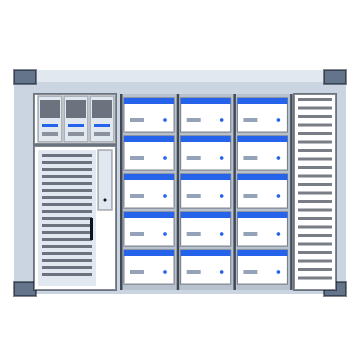
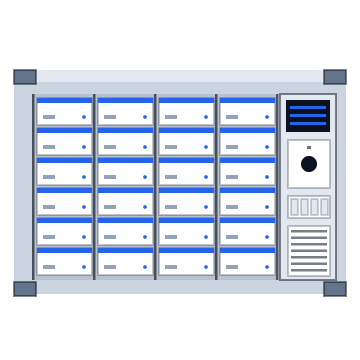
Un AC block es un producto de almacenamiento de energía por baterías completamente integrado que reúne módulos de batería, BMS, gestión térmica y PCS (sistema de conversión de potencia) en una sola unidad. A diferencia de los DC blocks, que requieren un convertidor externo, un AC block suministra directamente corriente alterna compatible con la red. Para los equipos de compras, esta arquitectura todo en uno simplifica la integración del sistema, reduce el número de relaciones con proveedores y disminuye la complejidad del BoP.
Los AC blocks se utilizan con mayor frecuencia en aplicaciones C&I y proyectos utility-scale de menor tamaño, donde la simplicidad y la puesta en marcha rápida son prioritarias. Para proyectos grandes, la adquisición separada de DC blocks y PCS ofrece más flexibilidad arquitectónica y mejores posiciones de negociación.
Especificaciones clave
Qué comparar al evaluar AC blocks
Al preseleccionar para un proyecto BESS, estas son las especificaciones técnicas clave que las empresas EPC, desarrolladores e integradores de sistemas suelen evaluar:
Tasa C
0,25C – 1C
Determina la potencia máxima de carga/descarga en relación con la capacidad. La mayoría de los AC blocks están diseñados para 0,5C, equilibrando rendimiento y vida útil.
Capacidad energética
215 kWh – 10 MWh
Los AC blocks cubren un amplio rango — desde unidades C&I (215 kWh) hasta contenedores utility-scale (10 MWh). El tamaño óptimo depende de la aplicación y la arquitectura del sistema.
Química
LFP dominante
LFP es la química estándar para AC blocks por su perfil de seguridad y vida útil en ciclado. Algunos productos C&I usan NMC cuando se requiere mayor densidad energética.
Eficiencia round-trip
85 – 92 %
Eficiencia medida en el lado AC, incluyendo las pérdidas del PCS. Típicamente algo inferior a los sistemas DC block + PCS separados, ya que el PCS integrado no siempre opera en su punto de funcionamiento óptimo.
Método de refrigeración
Líquida o por aire
Los AC blocks utility-scale más grandes utilizan cada vez más refrigeración líquida. Las unidades C&I más pequeñas suelen usar refrigeración por aire.
Certificaciones
UL 9540A, IEC 62619
Mismas certificaciones base que los DC blocks. Al tener el PCS integrado, el AC block debe además cumplir los requisitos de conexión a red (ej. código de red español) a nivel de sistema.
Preguntas frecuentes
Preguntas frecuentes
¿Cuál es la diferencia entre un AC block y un DC block?
Un AC block integra la batería y el PCS en una sola unidad y suministra directamente corriente alterna. Un DC block contiene solo la batería, el BMS y la gestión térmica — requiere un PCS externo separado para la conexión a red. Los AC blocks simplifican la integración; los DC blocks ofrecen más flexibilidad arquitectónica.
¿Cuándo se debe elegir un AC block en lugar de un DC block?
Los AC blocks son especialmente adecuados para aplicaciones C&I, proyectos utility-scale de menor tamaño y situaciones donde la puesta en marcha rápida, menor complejidad de proveedores y un BoP mínimo son más importantes que la flexibilidad arquitectónica total. Para proyectos utility-scale grandes (50+ MWh), la mayoría de los desarrolladores prefieren DC blocks con PCS separado para optimizar independientemente la adquisición y el diseño del sistema.
¿Qué certificaciones debe tener un AC block?
Los AC blocks necesitan las mismas certificaciones base que los DC blocks (UL 9540A, IEC 62619) más acreditaciones adicionales para el PCS integrado, incluyendo conformidad con los códigos de red (código de red español, RD 413/2014) y seguridad de electrónica de potencia (IEC 62477). Al ser el AC block una unidad completamente integrada, los ensayos del sistema deben cubrir la interacción de todos los componentes.
¿Cuál es el rango de capacidad típico de los AC blocks?
Los AC blocks van desde aproximadamente 215 kWh (unidades C&I compactas) hasta más de 10 MWh (productos utility-scale en contenedor). La mayoría de los AC blocks C&I se sitúan entre 200 kWh y 1 MWh, mientras que las variantes utility-scale ofrecen típicamente 3–10 MWh por unidad. La elección depende del tamaño del proyecto, las restricciones del emplazamiento y la arquitectura de sistema deseada.
Este sitio utiliza analítica sin cookies para entender cómo lo usan los visitantes. No se recopilan ni comparten datos personales. Política de privacidad